

- Date:
- 3 Aug 2026
Portable Long Service Authority Corporate Plan 2026-30
The Corporate Plan 2026-30 for the Portable Long Service Benefits Authority (the Authority) covers the period 2026-30 and sets out the Authority’s short- and medium-term priorities along with its key measures for success.
Accessibility
We've provided as much of this Corporate Plan in HTML as practicable.
For accessibility assistance understanding this report, email us at enquiries@plsa.vic.gov.au.(opens in a new window)
Introduction
Message from the Chairperson and Chief Executive Officer / Registrar
We are pleased to present the 2026–30 Corporate Plan of the Portable Long Service Authority (the Authority).
This is the Authority’s third Corporate Plan and sets out our key objectives and strategic priorities for the next four years as we continue to deliver, strengthen and mature operations of Victoria’s Portable Long Service Benefits Scheme (the Scheme).
Since commencing operations, the Authority has evolved into a well-established independent statutory agency administering one of Australia’s largest portable long service benefit schemes. Portable long service benefit schemes help support workforce mobility by protecting portable long service leave entitlements for workers in covered industries.
Under the Long Service Benefits Portability Act 2018, the Authority is responsible for the following 3 key objectives:
- Scheme Administration: this being the effective administration of the Scheme including the correct registration of employers and workers as well as the accurate record keeping of benefits and liabilities;
- Financial Management: the safe custody and prudent investment of worker entitlement funds at a strong rate of return; and
- Enforcement of the Scheme: the careful exercise of enforcement powers to ensure employers comply with their statutory obligations.
As part of the Authority’s planning processes, the Governing Board has identified the following strategic priorities as being most important to the achievement of the Authority’s objectives over the period of this 2026-30 Corporate Plan:
- Enhancing stakeholder engagement activities
- Prudent but impactful investment in technology solutions
- Streamlining claims processing
- Appropriate use of compliance and enforcement powers to maintain Scheme integrity
Victoria is a leader in portable long service leave with the Authority’s Scheme covering the community services, contract cleaning and security industries. Similar schemes exist in some but not all of these industries in other Australian States. With new schemes being proposed, or are in the process of being established in other Australian States, we are confident that the successful execution of the above strategic priorities will enable the Authority in Victoria to remain a leader in portable long service leave into the future.
Julius Roe
Chair, Governing Board
Joseph Yeung
Chief Executive Officer / Registrar
Who we are
Vision
Delivering a quality Scheme to protect the benefits of those who are entitled to them.
Purpose
The Authority administers an effective Scheme through prudent, sustainable investment and supporting all stakeholders, including employers and workers alike, as well as educating and enforcing every stakeholder’s role and interest in the Scheme.
Independence
The Authority is an independent statutory body established to administer the Scheme under the Long Service Benefits Portability Act 2018 (the Act), to provide portability of long service benefits in the community services, contract cleaning and security industries.
Our Shared Values
The Authority adheres to the Victorian public sector values, which underpin the behaviours that the government and community rightly expect of it. Acting consistently with these values strengthens the Authority’s capacity to operate effectively and achieve our objectives. These values are:
- Responsiveness: We are approachable and provide timely, useful and accurate information.
- Integrity: We have unbiased and honest interactions.
- Impartiality: We are firm and consistent in our application of the law.
- Accountability: We fulfil our objectives in a clear, transparent and responsible manner.
- Respect: We respect our stakeholders, each other and ourselves.
- Leadership: We are public officials who should lead from the front by actively implementing, promoting and supporting these values.
- Human Rights: We administer the law and deliver decisions, advice and policy that respect and support everyone’s human rights.
Organisational structure
The Authority's governance and organisational structure.
Governance and organisational structure
The Authority operates under a robust governance framework designed to ensure accountability, strategic oversight and compliance with legislation and public sector standards. The responsible entity of the Authority is the Governing Board, which is appointed by the Victorian Minister for Industrial Relations. The Governing Board comprises individuals with expertise and diverse experiences relevant to representing both employers and workers of the Scheme.
The Governing Board has statutory responsibility for the Authority’s governance, strategic planning and risk management in accordance with section 38 of the Act and the standards set out in the Public Administration Act 2004 (Vic).
Governing Board members adhere to the standards of the Code of Conduct for Directors of Victorian Public Entities 2024 and the Public Administration Act 2004 (Vic).
The Audit and Risk Committee provides independent assurance and advice to the Governing Board on the effectiveness of the Authority’s financial management, internal controls, legislative and regulatory compliance and risk management framework.
The CEO / Registrar, who is a member of the Governing Board, is responsible for the day-to-day management of the Authority and its operations.
Business Units deliver strategic objectives through day-to-day operations. They manage risks within their area of accountability, maintain effective controls, report on performance and escalate emerging issues.
Minister
The Hon. Colin Brooks MP
Treasurer
Minister for Industrial Relations
Governing Board
Chair
Julius Roe
Deputy Chair
Claire Filson
Members
Juanita Pope
Lloyd Williams
Nicholas Richardson
Phillipa Balk
Rachaell Saunders
Tim Piper AM
Member / Registrar
Joseph Yeung
Audit and Risk Committee
Chair
Claire Filson
Members
Rachaell Saunders
Lloyd Williams
Independent Member
Stephen Brown
Appointed Actuary
Fellow of the Institute of Actuaries of Australia
Andrew Boal
Diane Somerville
Business Units
Operations
Finance
Investigations and Enforcement
Technology
People and Culture
Communications and Engagement
Legal
Operating environment
Our operating environment
The Authority operates within a complex legislative, economic, industrial and social environment. The Scheme’s effectiveness relies on the active participation of employers and workers.
External factors
Performance is influenced not only by the design and governance of the Scheme itself, but also by broader labour market trends, industry practices, regulatory requirements and the evolving expectations of the Victorian community.
Factors outside the Authority’s direct control, such as economic conditions, workforce mobility, sector‑specific employment patterns, and changes to legislation, can influence the financial performance and the effectiveness of the Scheme’s compliance activities.
Also important to the Authority are stakeholder expectations and community perceptions which may influence public confidence in the Scheme.
Both micro-economic and macro-economic factors can affect the levy rate required for the ongoing sustainability of the Scheme.
Micro-economic factors include employer behaviours such as company liquidations, non-reporting of workers or under-reporting of worker hours. These can all affect the levy rate for the Scheme. Separately, macro-economic factors include demographic shifts in the covered workforces of the Scheme and global investment conditions that can impact the return on the Scheme’s investment objectives and valuation of assets.
Portable long service benefits recognition and measurement
Workers in the community services, contract cleaning and security industries become entitled to portable long service benefits after seven years of recognised service. In accordance with relevant accounting and actuarial requirements, the Authority measures and records an accounting liability for these benefits based on the present value of expected future payments, adjusted for relevant risks specific to each covered sector in order to accurately measure this liability.
The calculations are performed by the Authority’s appointed actuary using an actuarial valuation method that takes into account assumptions including but not limited to estimated rates of departure from and returns to the industry; mortality rates; disability rates; expected rates of increase in wages in the industries of covered workers; discount rates; and the projected rates of return on the Authority’s investments.
Internal factors
Internal factors also impact and influence the performance of the Authority and the Scheme. In particular, the Authority’s organisational structure, workforce capability as well as the adequacy of its systems and processes that underpin the effective administration of the Scheme. These internal capabilities enable the Authority to maintain accurate records, undertake risk-based compliance and enforcement activities, and ensure sound financial management.
As the Authority continues to mature, ongoing investment in systems, data, capability and processes will further enhance service delivery and responsiveness to emerging operational demands. Our ability to adapt to changing conditions and embed continuous improvement practices remains critical to sustaining high performance and meeting our strategic objectives.
Executing our responsibilities
The Authority’s success is the sum of its parts. The different Business Units that comprise the Authority span multiple operational roles and functions performed by the staff of the Authority.
This operates as an integrated system where the Authority values the work of each staff member and their contributions to the overall achievement of the Authority’s objectives.
Our people
Our workforce is a critical enabler of organisational performance and long term success. We recognise that achieving our strategic objectives relies on the skills, professionalism, and wellbeing of our people. We are committed to attracting, developing, and retaining a capable and engaged workforce, supported by a positive culture and strong leadership, so we can continue to deliver on our statutory responsibilities with excellence.
Integrated role of the Authority
Compliance and enforcement
- Compliance monitoring
- Investigations
- Prosecutions
- Corporate governance
Engage and educate
- Worker and employer awareness and engagement
- Contact centre
- Guidance and support
Registration
- Registration under the Act: Employers and workers
- Accurate collection of data
Reporting service
- Employer reporting
- Data validation
- Missing service
- Benefit and liabilities
Funds and sustainability
- Levy setting
- Levy collection
- Funds investment
Deliver entitlements
- Claims processing
- Assessments
- Levy payments
- Debtor management
Risk management
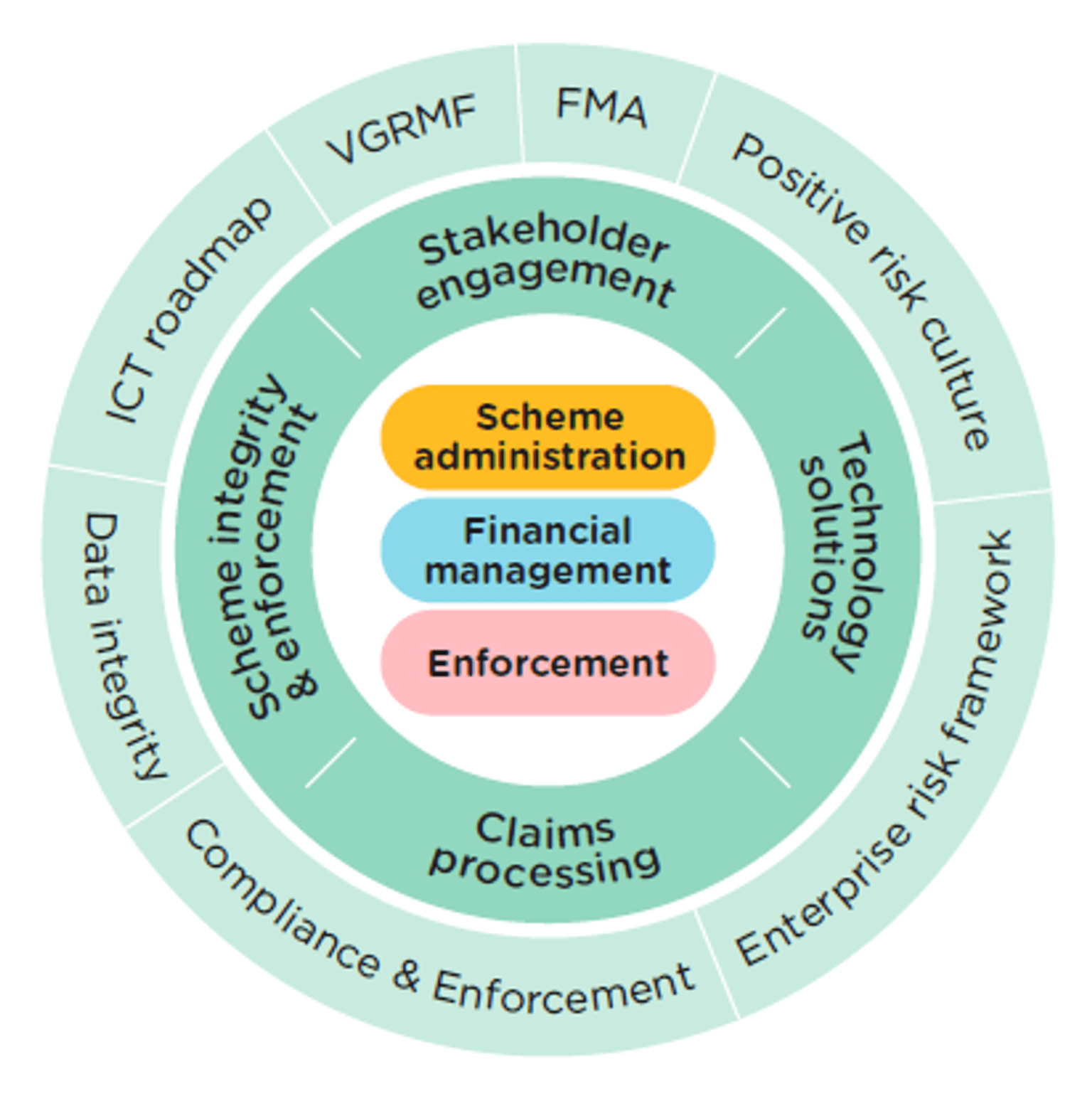
We manage risk in line with the Victorian Government Risk Management Framework (VGRMF) and the Financial Management Act 1994 (FMA). These requirements guide how we assess and manage risks and report on our performance.
Effective risk management supports the delivery of our objectives and enables informed decision‑making across the Authority. We actively promote a positive risk culture, where staff are encouraged to identify, report and manage risks in their day‑to‑day work. As the Authority continues to grow, we are focused on developing our risk maturity to support organisational needs. Key enterprise, operational and financial risks are actively managed through our risk and financial management frameworks and compliance monitoring.
The Authority’s Corporate Plan sets out clear objectives and strategic priorities, supported by targeted actions to mitigate key risks and respond to emerging issues. To address our most significant risks, the Corporate Plan outlines several priority areas to strengthen the Authority’s capability and the integrity of the Scheme. This includes ensuring workers are aware of their benefits and can access them.
Delivering the ICT roadmap is a strategic priority to reduce enterprise technology risk, strengthen core infrastructure, and enhance technology and data analytic capability to support effective regulation and decision‑making.
Stakeholder engagement and streamlining end‑to‑end processes will improve stakeholder identification, communication and participation in the Scheme, helping to reduce the risk of missed or delayed registration and reporting.
Under‑registration and non‑compliance remain key risks to Scheme integrity. We will apply a risk‑based, proportionate compliance approach, supported by clear guidance and appropriate escalation to enforcement action where required, to deter non‑compliance and uphold fairness for employers that meet their obligations.
Collectively, enhancements to claim processing, scheme engagement and technology‑enabled solutions support the accuracy and completeness of Scheme data, which underpins sound financial management and contributes to the long‑term financial viability of the Scheme.
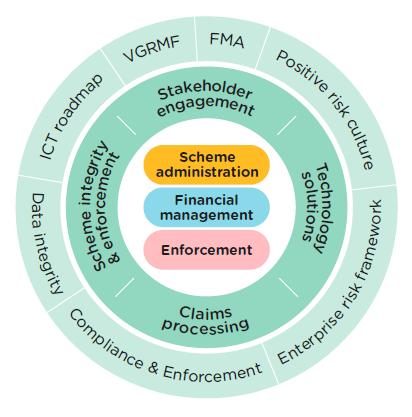
Risk management ecosystem
Authority objectives
The Authority’s legislative functions, set out in section 36 of the Long Service Benefits Portability Act 2018, direct our strategic priorities and objectives.
Authority objectives
This 2026-30 Corporate Plan sets out the Authority’s key objectives and strategic priorities for the four-year period.
The Authority’s three key objectives during this period reflect our core responsibilities to deliver effective Scheme administration, responsible financial management and risk-based regulatory and enforcement activities.
Our measures of success
For each strategic objective, we have defined commitments and success indicators to guide planning, monitor performance and support governance across the Authority. Details for each of the three objectives are provided below.
The Authority’s three key objectives
- Scheme administration: The correct registration of employers and workers as well as the accurate record keeping of benefits and liabilities.
- Financial management: The custody and investment management of worker entitlement funds to achieve strong long-term investment performance over the life of the Scheme.
- Enforcement: Risk-based, proportionate compliance with clear and appropriate escalation to enforcement.
Scheme administration
Scheme administration encompasses the Authority’s registry and scheme administration responsibilities, including engagement, registration, resolution, quarterly returns, levies and worker claim processing.
Our commitments
- Engage and educate: We will improve Scheme understanding through targeted outreach, clear guidance and consistent stakeholder engagement.
- Enquiries: We will provide responsive, accurate, multichannel support to help employers and workers meet their obligations with confidence.
- Registration: We will streamline registration processing, strengthen data integrity and insights and expand participation through targeted campaigns.
- Quarterly returns: We will support accurate and timely reporting using clear tools, proactive follow up, and insights that identify and reduce compliance risks.
- Levy payments: We will maintain efficient and transparent levy collection, supported by risk-based compliance and improved payment processes.
- Worker claims: We will ensure fair and timely access to entitlements through efficient processing, clear standards and strong quality assurance.
Headline indicators
- Timely submission of accurate quarterly returns by registered employers
- Timely payment of levies by registered employers
- Authority processing of worker claims within statutory timeframes
- High registration accuracy and completeness
- Increased capacity to maintain contact with workers when they change their employer.
Financial management
We sustain the Scheme by setting and reviewing levy rates, receipting levies paid by employers, strategically investing funds and maintaining strong financial oversight, to ensure we can meet worker entitlement payments both now and into the future.
We safeguard financial integrity and long-term sustainability of the Scheme through prudent financial management and robust risk controls.
Our commitments
- Financial sustainability: We will maintain a strong and resilient financial position by monitoring liabilities, investment strategies with projected worker benefits, and ensuring long-term sufficiency of Scheme assets to meet future obligations.
- Investment management: We will pursue a disciplined investment approach focused on responsible returns, diversification and alignment with risk appetite to support the Scheme’s ongoing viability.
- Risk management: We will manage financial risks proactively through strong governance, clear oversight mechanisms and regular stress-testing to ensure the Scheme remains secure under varying economic conditions.
- Levy rates: We will regularly assess and forecast benefit liabilities and levy rates to ensure timely funding, accurate provisioning, and a clear understanding of future obligations.
Headline indicators
- Scheme funding sufficient to meet projected liabilities
- High levy collection rates
- Investment performance aligned with benchmarks and risk appetite.
Enforcement
The Authority applies a risk based and proportionate regulatory approach that targets behaviours most likely to undermine worker entitlements. To protect the integrity of the Scheme we will utilise our suite of regulatory tools, undertaking monitoring, investigations and where necessary escalate to enforcement actions where appropriate – and in the public interest. Our priority areas include identifying unregistered employers, addressing overdue and/or inaccurate quarterly returns, overdue levies and targeting under-registration and missing service for workers.
Our commitments
- Risk-based compliance monitoring: We will target compliance activity where the risk to worker entitlements is highest, using data insights to identify emerging trends and direct resources efficiently.
- Investigations and enforcement: We will undertake timely investigations into suspected noncompliance and apply proportionate enforcement responses, escalating to prosecution where it is in the public interest.
- Unregistered employers: We will identify employers operating outside the Scheme and take action to bring them into compliance, safeguarding workers who may otherwise miss out on entitlements.
- Quarterly return integrity: We will focus on overdue, inaccurate, or incomplete quarterly returns, supporting employers to correct issues while addressing deliberate or repeated noncompliance.
- Worker registration and service accuracy: We will address under-registration and missing service to ensure all covered workers have accurate, complete entitlement records now and in the future.
- Employer education and guidance: We will support employers to comply through education and practical guidance, clearly communicating expectations and escalating where necessary.
Headline indicators
- A reduction in unregistered covered employers who fail to register with the Scheme.
- A reduction in employers who fail to submit quarterly returns in line with their obligations.
- A reduction in employers who fail to register and report accurately on their workers.
Our strategic priorities
Our strategic priorities 2026-30
As part of the Authority’s planning processes, the Governing Board has identified the following four strategic priorities as being most important to the achievement of the Authority’s objectives.
Each of these four strategic priorities is linked to one or more objectives of the Authority, as identified below each strategic priority.
Priority 1: Enhancing stakeholder engagement activities
The Authority will work with stakeholders to support understanding of Scheme obligations and benefits. This includes education for employers on quarterly returns, worker data requirements and entitlements, and strengthened engagement with workers, particularly when they change employers. We will continue to educate new employers and workers entering covered industries and, where beneficial, work with representative bodies and other relevant stakeholders, including State and Commonwealth regulators, to achieve the best outcomes for the Scheme.
Objectives linked to this priority
- Scheme administration
- Financial management
- Enforcement
Priority 2: Prudent but impactful investment in technology solutions
Advance the Authority’s technology capability to support effective Scheme administration, meet the needs of a growing registrant base, and leverage modern data and analytics. This will include enhancement of our capacity to identify under-registration of employers and workers. As part of our ICT roadmap, we will deliver targeted system enhancements to strengthen our core technology infrastructure, enable more efficient processes and ensure we remain well‑positioned to respond to emerging technology opportunities and risks.
Objectives linked to this priority
- Scheme administration
- Financial management
- Enforcement
Priority 3: Streamlining claims processing
The commencement of claims processing for covered workers after 7 years of service in the industry will significantly increase the Authority’s processing volumes. The Authority is prepared for this work and is committed to ensuring covered workers can access their portable long service benefits easily.
Objectives linked to this priority
- Scheme administration
- Financial management
Priority 4: Appropriate use of enforcement powers to maintain Scheme integrity
The Authority will reduce the incidence of under-registration of both employers and workers. Most employers are meeting their obligations to register and make contributions on behalf of their workers. However, deliberate under-registration and non-compliance remain key risks to the integrity of the Scheme. Where such risks to the Scheme are identified, the Authority will use its enforcement powers to prosecute and fine employers that fail to comply with their obligations.
Objectives linked to this priority
- Scheme administration
- Enforcement
Financial outlook
The financial outlook provides a structured and disciplined approach to the management of the Authority’s resources, ensuring service delivery is maintained within available funds.
The Governing Board is responsible for overseeing the prioritisation and use of the Authority’s resources to ensure financial sustainability and alignment with the Authority’s objectives and strategic priorities.
As a fully self-funded entity, the Board oversees the prioritisation and use of these resources to ensure financial sustainability and alignment with our strategic objectives.
Table 1: Projected summary operating statement
| 2026-27 ($’million) | 2027-28 ($’million) | 2028-29 ($’million) | 2029-30 ($’million) | |
| Employer and contractor levies | 223.9 | 242.2 | 261.9 | 283.3 |
| Investment income | 59.2 | 70.8 | 81.8 | 92.8 |
| Other income | 1.5 | 1.4 | 1.6 | 1.7 |
| Total expenses | 255.4 | 282.0 | 308.2 | 333.1 |
| Projected net result | 29.2 | 32.4 | 37.1 | 44.7 |
Table 2: Projected funding for major assets – estimates
| 2026-27 ($’million) | 2027-28 ($’million) | 2028-29 ($’million) | 2029-30 ($’million) | |
| Infrastructure investment | 5.0 | 5.0 | 2.5 | - |
Table 3: Summary investment projections - Portable Long Service Benefits Scheme
| 2026-27 ($’million) | 2027-28 ($’million) | 2028-29 ($’million) | 2029-30 ($’million) | |
| Opening investment balance | 911.3 | 1,113.4 | 1,308.4 | 1,490.5 |
| Net contributions | 221.6 | 239.7 | 259.4 | 280.5 |
| Net investment returns | 59.2 | 70.8 | 81.8 | 92.8 |
| Net withdrawals | 78.7 | 115.5 | 159.1 | 177.8 |
| Projected closing balance | 1,113.4 | 1,308.4 | 1,490.5 | 1,686.0 |